Home

Galleries

Artist Info

Video Clips

Synesthesia

Calendar

Contact

Site Map

Links

Press


Blog

Exhibitions

Researcher
Reflections


Upcoming  Exhibit:

McMaster Museum
Art and the Mind
Hamilton, Ontario
Canada

September 18 - October 18, 2008


Upcoming  Lecture:

What Does A Metaphor Look Like?
McMaster University
Professor Daphne Maurer, Host
Department of Psychology, Neuroscience And Behavior
7th Annual National Conference
American Synesthesia Association
Hamilton, Ontario
Canada
September 26-28, 2008
See Abstract Below


Current Exhibition:

James Schot Gallery Photo Studio
Sublime Distractions
2800 N Federal Highway, Suite A
Fort Lauderdale, Florida 33306
USA
April 18 -June 14, 2008


Wellesley College
Professor Bevil Conway, Host
Lecture for Vision and Art Class
April 8, 2008


Radio Interview
FASHIONISTA'S CORNER
Blog Talk Radio
February 2, 2008


Television Interview
 MVTV
Vineyard View with Ann Bassett

January 2008


Weekend America
Public Radio

"A Different Sense of Things"
Produced By
  Kara Oehler and Ann Hepperman, Peabody Winners
Saturday May 26, 2007


*Listen at:  A Different Sense of Things


Lecture:
The Language of Synesthesia

University of South Florida
St. Petersburg, Florida
6th Annual National Conference
American Synesthesia Association, Inc.

January 26-28, 2007
http://synesthesia.info

See Abstract Below


Mirai No Hosoku
or Uncharted Future
Documentary Film For
Japanese Television
Produced By The East Company
Tokyo Japan
December 31, 2006


Lecture:
Synesthesia and Perception

The School for Visual Arts
Artists Talk About Art Series
New York City, NY
December 8, 2006


Lecture:
Using Synesthesia To Create Paintings By Camera

Department of Clinical Psychiatry And Psychotherapy

Hanover Medical School
Hanover, Germany

2nd International Conference on Synesthesia
December 1 - 3, 2006


Lecture:
When A Window Is Also A Mirror

University of Texas
Houston Medical School
Houston, Texas
Fifth Annual National Conference
American Synesthesia Association

October 28-30, 2005

See Abstract Below


Lecture:
Synesthetic Sonar Between Artist and Archetype:
Photographic Proof That The Universe Is Dreaming

The College Art Association
Atlanta, Georgia
February 16-19, 2005

See Abstract Below


Lecture:
The Singing Arches

Institute of Cognitive and Brain Sciences
University of California
Berkeley, California
Fourth Annual National Meeting
American Synesthesia Association

November 5-7, 2004
See Abstract Below


Review of Conference in Leonardo by Amy Ione


Lecture:
Weekends are Taller than Weekdays

The Rockefeller Institute
Neurogenetics Laboratory
New York City, New York
Third Annual National Meeting
American Synesthesia Association
May 2-4, 2003

www.synesthesia.info/rockefeller.html


Lecture:
Synesthesia Evening

Synergy Design Center
Vineyard Haven, MA
Art Presentation by Marcia Smilack
Reading by Patricia Duffy Author from
Blue Cats and Chartreuse Kittens
Poetry Reading by Rose Styron
July 22, 2003


Lecture:
How I Used Synesthesia
To Teach Myself Photography

Yale University
The Pierce Laboratory
 Dr. Lawrence Marks, Host
New Haven, Connecticut


Lecture:
Dreams, Synesthesia and Photography

Feather Stone
Meeting House For The Arts
Oak Bluffs, MA
USA


Lecture:
How Synesthetes Color Their World

Bunch of Grapes Bookstore, Authors Series:
Vineyard Haven, MA
Reading By Author Patricia Duffy from
Blue Cats and Chartreuse Kittens


Lecture:
How I Write . . . by Marcia Smilack

Feather Stone
Meeting House For the Arts
Oak Bluffs, MA
USA


Lecture:
Synesthesia: What Is It?

Doctors Meeting
Martha’s Vineyard Hospital
Oak Bluffs, MA


Lecture:
How I See In Reflection

Harvard University
Graduate School of Landscape Design
Cambridge, MA


ABSTRACTS OF LECTURES


Upcoming:

McMASTER UNIVERSITY
Department of Psychology, Neuroscience & Behaviour
Hamilton, Ontario, Canada
7th Annual National Conference
American Synesthesia Association
September 26-28, 2008


Grey Eyes by Marcia Smilack


What Does A Metaphor Look Like?


I asked a friend what a metaphor looks like to her, explaining that for me, a metaphor has four compartments. She said her metaphor has just two, like a room with a window, which made no sense until I had this dream. We entered a cottage and immediately the door flew shut. When I touched the handle, the door dissolved and became the wall. So, I tried the window, but it too dissolved and became the wall. Sealed inside, I said, “Well, I guess we are inside your metaphor now.”


Why does my metaphor have four compartments? Does hers have only two because as a non-synesthete, one plus one equals two? For me, one plus one equals four because everything I experience comes with a built-in second version. I live my life in metaphor, which accounts for my eidetic memory. I could not create my artwork without it.


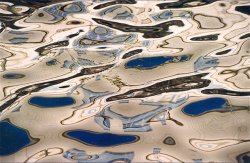
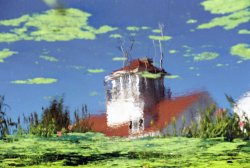
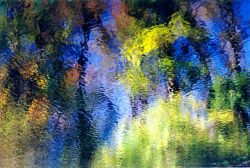
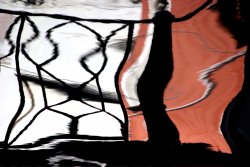
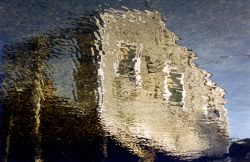
After noticing that reflections trigger my synesthetic responses, I began to photograph them on water. I used my synesthetic responses to teach myself photography. I click the shutter when I hear a chord of color, experience motion, or feel texture on my skin. Also, from extreme empathy, I briefly become what I am looking at and cannot help but personify what I see. My pictures of houses become pictures of people because the windows are eyes. Are partitions within the non-synesthetic mind like bearing walls whereas my own are mere curtains easily set aside? My photographs document my synesthesia.


 University of South Florida
St. Petersburg, Florida
The 6th Annual National Conference
American Synesthesia Association, Inc.
http://synesthesia.info


Furry Light / Chimes by Marcia Smilack

The Language of Synesthesia

I am a bi-directional synesthete who experiences multiple forms of synesthesia. I photograph reflections on moving water and click the shutter at the moment I experience a texture or sound response. For that reason, a researcher asked for my input on his invention to convert images of one's surroundings into sound to help blind people see.

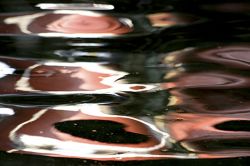
I sent him photographs of sounds which I selected from the thousands of photos I have taken in the last twenty years that document my synesthetic responses. However, he explained that as no two synesthetes perceive the same way, my images were most likely not universal enough to be useful for his purposes. But that planted an idea in me. Were there any universals? I sorted my images into two piles, putting the sound pile in front of me, shoving the texture pile to the side because I didn't expect to use it. Suddenly, I heard the sound of chimes, only it was coming from the wrong place: peripherally seen, the top image of the texture pile was eliciting the chime sound. When this happened a second time, I found my eureka moment.

To test my hunch of universality, I began an experiment in which I asked non-synesthetes to match sounds to the images I presented. No one had difficulty matching the image to the chime sound. So, now I am considering: first, could my two senses have traded places in the layers of conscious awareness; and second, am I more likely to find universal shapes for sound amid my texture images where they may be hidden even from me; and third, do these images elicit similar responses in both synesthetes and non-synesthetes alike. I wish to share the results of similar experiments at the conference in the hope of learning more about the language of synesthesia.


University of Texas
Houston Medical School
Houston, Texas
Fifth Annual National Conference
American Synesthesia Association

October 28-30, 2005


Mirror to Nature by Marcia Smilackcollege

When A Window  Is Also A Mirror


A Dream: I am sitting at a semi-circular desk wrapped around my waist snug as a baby’s highchair. The desk is like any desk except for where it is: the middle of the ocean. I am dry as a landlocked scribe from the waist up, but from the waist down, my body is submerged. My chair is actually a bicycle, my feet touching pedals underwater. I discover a button on my computer that catapults me into live music without my having to get up from the chair, or bike, or out of the water. I am a female centaur, hooves replaced by aquatic wheels - half rider, half writer – which is why in waking life (I think later), when I mean to type “write” I see “ride” appear on my computer screen, as though my fingers think in homonyms and take dictation from voices I can’t hear.

This dream provides the perfect metaphor for how synesthesia feels, although in waking life, I have no magic button to initiate the experience. I look to Nature instead, specifically reflections on water where light, at certain times of day, sends me into multiple modalities. I experience sound, texture, and motion but never voluntarily, so I put myself in the vicinity of where I know it might occur. My images elicit the same synesthetic responses every time I see them. By sharing them, I hope to transform Nature’s mirror into a useful window for us all.


The College Art Association
Annual Meeting, 2005
Atlanta, Georgia
February 16-19, 2005


Cello Music by Marcia Smilack


The Synesthetic Sonar From Artist To Archetype;

Photographic Proof That The Universe Is Dreaming


In a recent dream, I found myself standing inside a second floor shop in New York City where my eye was drawn to a large black square of canvas laid out on a table for display. Up close, I saw a scattering of tiny colors embedded in the folds of the cloth like sequins except they had no shine until I touched them. As soon as I made contact, they brightened and turned into musical notes. I found that if I rubbed my forearms on the cloth, paying particular attention to press my elbows into the colors, I could play piano music – - not music that was “like” piano music but music that WAS piano music. I was delighted to find a piano so lightweight I could roll it up and carry it with me like a painting.

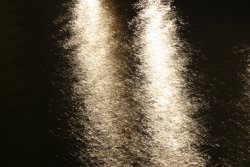
In waking life, I had a similar experience the first time I photographed cello music though perhaps I should first explain what it is I do. I photograph reflections on the surface of water and call myself a Reflectionist. I taught myself photography by shooting whenever I heard a chord of color, one of my synesthetic responses to what I see. On the night I took the cello image, the setting sun, reflected on the water, turned the skin of the sea to a golden hue that, in combination with the wave formation, created/creates for me the sound of cello, though the actual instrument was no more a cello than the dreamed piano.

The difference between the two experiences came to me when a scientist who attended an exhibition of mine spoke about my cello image. He explained that it was no surprise I heard cello music since I had captured on film the exact sine waves produced by the sound of cello strings, an insight I found fascinating since I had no idea I had done any such thing, though it gave me this idea: that the synesthesia artists experience in their work operates like an internal sonar that takes them directly to the archetypal patterns we know exist in art as well as science; and that my images, which look like dreams from a collective unconscious, are evidence if not proof that the universe is dreaming.


Institute of Cognitive and Brain Sciences
University of California
Berkeley, California
Fourth Annual National Meeting
American Synesthesia Association

November 5-7, 2004


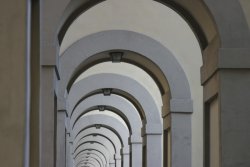
Singing Arches by Marcia Smilack

Singing Arches


The art presentation I wish to give at the Fourth American Synesthesia Association Conference is titled "Singing Arches." I intend to share a small collection of images which, like my usual work, are photographs I take of reflections on water. My images are not only inspired by my synesthetic responses to what I see, hear, and feel; they are, in fact, the direct result of those responses.

The pictures I wish to share in my lecture are from a recent trip I took to Italy where, much to my surprise, the dominating synesthetic response I experienced was not of the color-sound, texture or motion variety I feel when I shoot images off the coast of Massachusetts. In Italy, I was most influenced by my response to shapes and geometry contained in the architecture, particularly arches which elicited, among other synesthetic responses, sound; the arches of Italy sang to me on a regular basis. I often remarked that I should have brought a tape recorder, not a camera, on my trip, for it was the sounds of Italy, not the sights, that affected me most strongly. As a synesthete, of course, my camera IS a kind of tape recorder, so it is those sounds, as they are captured in my pictures, that I wish to share with the audience.